
 EN

Fluidized Bed Granulator vs High Shear Granulator: Key Selection Factors
Choosing between a fluidized bed granulator and a high shear granulator is not a matter of selecting a universally better machine. In pharmaceutical solid-dose production, the right route depends on what the formulation needs before compression or filling: controlled particle growth, effective mixing, a defined moisture profile, efficient drying, or a robust transfer path to downstream sizing. A practical decision starts with the product and the validated process—not with the equipment brochure.
For process-development and engineering teams, the most useful comparison is therefore a process comparison. A fluidized bed granulator combines particle suspension, binder spraying, and continuous drying in one chamber. A high shear granulator uses an impeller and chopper to create intensive wet massing; it commonly requires a separate drying step. Both approaches can support oral solid dosage manufacturing, but their operating windows, failure modes, and scale-up questions differ.
Start With the Granulation Objective
A fluidized bed granulator is often considered when the process benefits from simultaneous granulation and drying. Powder is fluidized by conditioned air while binder liquid is sprayed into the moving bed. Because drying begins as granules form, this route can be attractive when reducing wet hold time or consolidating unit operations is important. It can also be useful when a formulation responds well to gradual liquid addition and controlled moisture removal.
High shear granulation takes a different path. The impeller distributes powder and binder under strong mechanical action, while the chopper helps break wet agglomerates and control the mass. This makes high shear granulation a common choice when fast wetting, intensive mixing, or a denser granule structure is needed. After wet massing, the granules typically move to a dryer, frequently a fluid-bed dryer in an industrial configuration.
The decision question is simple but important: does the formulation need integrated, air-driven granulation and drying, or does it need mechanical wet massing followed by separately controlled drying? Answering that question early prevents a comparison based only on batch time or purchase price.
Compare the Process Mechanisms Before Comparing Machine Features
| Selection factor | Fluidized bed granulator | High shear granulator |
|---|---|---|
| Primary energy input | Fluidizing air plus sprayed binder | Mechanical action from impeller and chopper |
| Drying approach | Drying occurs continuously during granulation | Usually requires a separate drying stage |
| Typical process emphasis | Moisture management and controlled coating of moving particles | Rapid wetting, mixing intensity, and wet-mass formation |
| Key development variables | Airflow, inlet-air condition, spray rate, atomization, bed temperature | Impeller speed, chopper speed, binder addition, wet-massing endpoint |
| Common systems view | One-pot granulation and drying route | Granulator plus dryer, with transfer between stages |
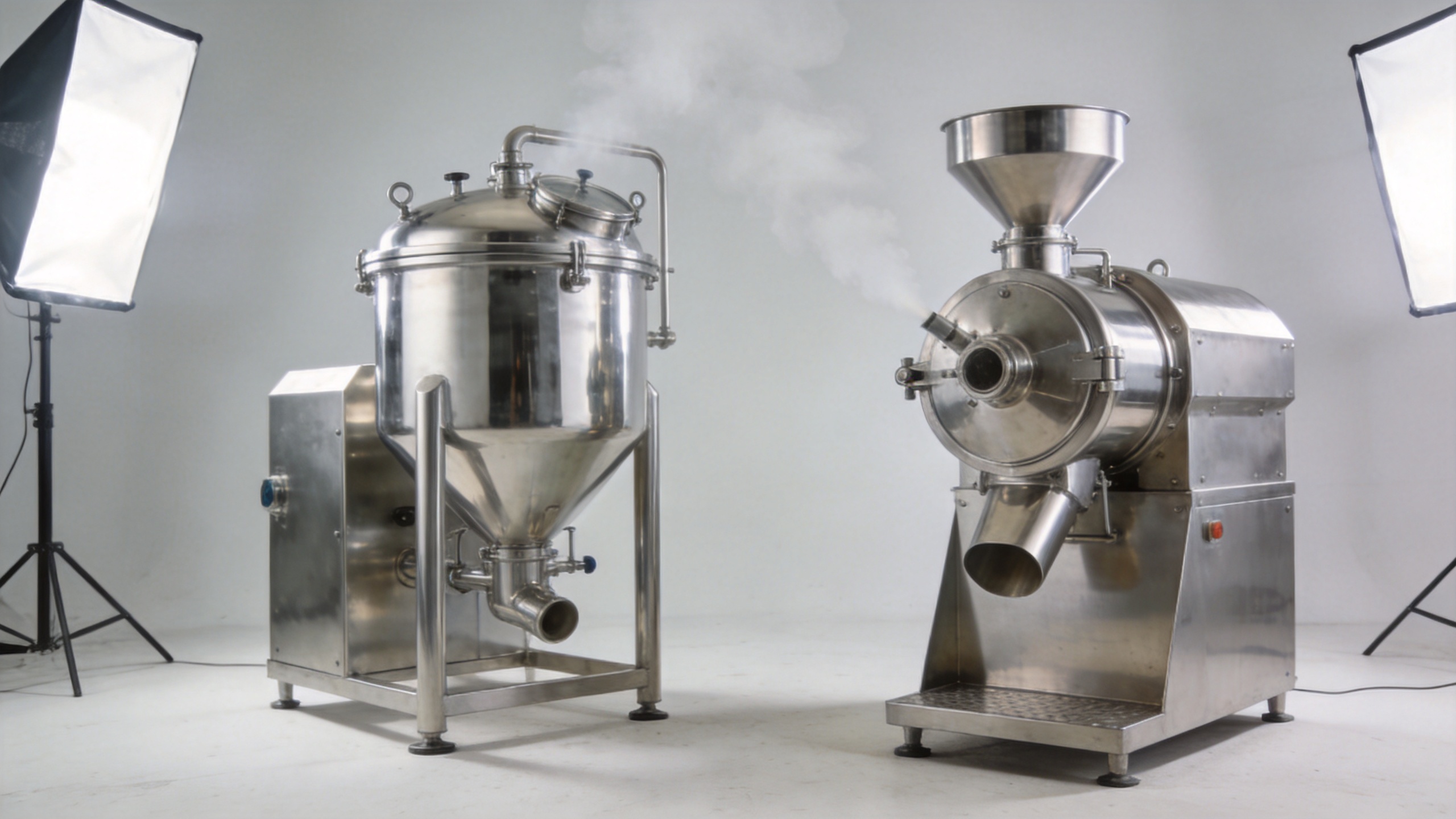
The table is a starting point, not a substitute for trials. Fluid-bed wet granulation uses air to suspend the material and applies binder to form granules while partial drying continues. High-shear and fluid-bed-drying combinations remain a common industrial configuration, which means a high-shear route should be evaluated as a system rather than as a standalone bowl.
Evaluate Drying Demand and Moisture Sensitivity
Drying demand is frequently the factor that shifts a project toward a fluidized bed granulator. If the product requires close control of residual moisture and the team wants to avoid prolonged wet holding, continuous drying can simplify the process narrative. It may also reduce the number of transfers and the amount of intermediate handling that must be controlled.
That does not mean the fluid-bed route is automatically gentler or easier. Air distribution, spray pattern, inlet-air temperature, and exhaust behavior must work together. A formulation that overwets can agglomerate; one that dries too quickly can produce weak granules or broad particle-size behavior. Powder flow, bulk density, particle-size distribution, and binder properties all affect whether the fluidized bed remains stable.
With high shear granulation, drying becomes a separate design decision. The team can optimize wet massing first and then define the drying profile in the next operation. This added flexibility can be valuable for formulations that need a clearly identifiable granulation endpoint. It also introduces interstage handling, cleaning, transfer, and containment considerations that must be included in the line design.
Match Equipment to Material Behavior and Product Attributes
Material behavior should be tested rather than inferred from a short ingredient list. Cohesive powders, low-dose blends, hygroscopic materials, and formulations with narrow moisture tolerances can react very differently to the two routes. In high shear processing, mechanical intensity may be useful where rapid binder distribution is needed. In a fluidized bed granulator, the ability to fluidize consistently is fundamental; poorly fluidizing blends can make the process difficult to control.
Define the desired granule attributes before selecting a platform: target size distribution, density, porosity, flowability, compactability, and residual moisture. Then map each attribute to the controllable variables and sampling plan. This approach is more reliable than treating either route as inherently superior. The suitable route is the one that produces the required attributes repeatedly within a practical control strategy.
Consider Line Integration, Cleaning, and Downstream Sizing
Equipment selection affects the full production train. A high-shear route commonly includes wet granulation, transfer, drying, milling or sizing, and final blending. A fluidized bed granulator may consolidate the first two major objectives, but it still needs well-designed discharge and downstream handling. The preferred layout depends on batch size, containment expectations, available utilities, cleaning validation, and the degree of automation required.
After drying, many operations need controlled particle-size conditioning before the next step. Where a separate sizing stage is part of the approved process, review equipment such as a fixed lifting granule sizing machine as a downstream integration option. Its suitability should be evaluated against the actual formulation, target particle-size distribution, transfer arrangement, and cleaning requirements; the product name alone does not establish process capability.
Cleaning is equally important. Ask where product can accumulate, how filters and spray systems are accessed, how parts are removed, and how cleaning verification fits the plant’s procedures. A short nominal cycle time can lose its advantage if changeover, cleaning, or transfer steps create operational bottlenecks.
Build the Selection Around Scale-Up and Validation
For pharmaceutical manufacture, equipment selection should support a documented process design and an eventual state of control. FDA process-validation guidance describes a lifecycle approach that begins with process design, continues through process qualification, and relies on continued verification. In practical terms, that means the selected route should provide meaningful process parameters, an explainable sampling strategy, and a scale-up path that the technical team can defend.
For a fluidized bed granulator, record the relationships among airflow, temperature, spray rate, atomization, bed behavior, and endpoint moisture. For a high shear granulator, establish how impeller and chopper settings, liquid addition, torque or power signals where available, and wet-massing time relate to the desired granule attributes. In both cases, development work should identify which parameters are critical for the specific product instead of copying generic settings from a different formula.
A Practical Selection Checklist
- Define the required granule attributes and acceptable moisture range.
- Assess whether the blend can fluidize consistently or needs intensive mechanical wetting.
- Compare integrated drying against a dedicated drying stage, including transfer risk.
- Run development trials that challenge the expected operating range, not only a nominal recipe.
- Review downstream sizing, blending, containment, cleaning, and maintenance as part of the full line.
- Select the route with the clearest scalable control strategy and documentation path.
Fluidized Bed Granulator Parameter Review
For a fluidized bed granulator project, document the powder’s fluidization response before setting a batch target. A fluidized bed granulator needs a stable bed, so test airflow across the blend’s particle-size and bulk-density range. During trials, evaluate the fluidized bed granulator at planned low, nominal, and high airflow conditions.
Binder delivery is another fluidized bed granulator decision. Spray rate, atomization, and nozzle position should be considered together because a change in one can alter local wetting. For moisture-sensitive materials, connect inlet-air condition, exhaust behavior, and endpoint moisture to the control strategy.
Scale-up needs the same discipline. A pilot fluidized bed granulator and a production unit can have different airflow patterns, so comparable process criteria matter more than copying settings. Before approval, confirm how sampling, discharge, cleaning, and downstream sizing will be represented in the commercial process.
- Can the material form a stable bed in the proposed fluidized bed granulator?
- Does the fluidized bed granulator provide the drying profile required by the formula?
- Will the fluidized bed granulator support the required batch size without compromising bed behavior?
- Which parameters will be monitored during process qualification?
These questions do not make a fluidized bed granulator the automatic choice. They make the comparison explicit: if it delivers repeatable granule attributes within the documented process window, it may be the appropriate route; otherwise, the high-shear route with separately optimized drying may be more practical.
Conclusion: Choose the Route That Fits the Process Window
A fluidized bed granulator can be a strong option when integrated granulation and drying, controlled moisture removal, and reduced handling align with the formulation. A high shear granulator can be the better fit when the product benefits from intensive wet massing and a separately optimized drying step. The most reliable decision comes from formulation trials, line-integration review, and a validation-minded assessment of controllable variables. Treat the choice as a process-development decision, and the resulting equipment specification will be more useful for manufacturing, quality, and long-term scale-up.